
As algo trading grows, are prop firm rules keeping up?
Velotrade reports that automation in trading is rising, leading to potential mismatches with existing prop firm rules.
Press Release Disclaimer: This is a press release distributed through the XPR Media network. It has not been independently verified by our newsroom.


spainter_vfx // Shutterstock
Automation has become standard equipment for traders taking a prop firm challenge. A review of the published rules at 15 firms finds a set of clauses written for discretionary traders that sit awkwardly against strategies that run themselves, and rulebooks that rarely separate those clauses from the ones addressing genuine abuse. Velotrade shares what a trader should read before paying an evaluation fee.
The trader taking a prop firm evaluation today is not the trader the evaluation was designed around. They are increasingly likely to arrive with a strategy already written, backtested and ready to run unattended, and increasingly likely to have bought or adapted one rather than built a trading bot from scratch.
The market data points in the same direction. Institutional desks still dominate algorithmic trading, holding about 61% of the market in 2025, but retail is the faster-growing segment, expanding at an 8.3% compound annual rate through 2031 as brokerages embed scripting environments directly into their platforms. Algorithmic trading stopped being a specialist discipline and became a feature.
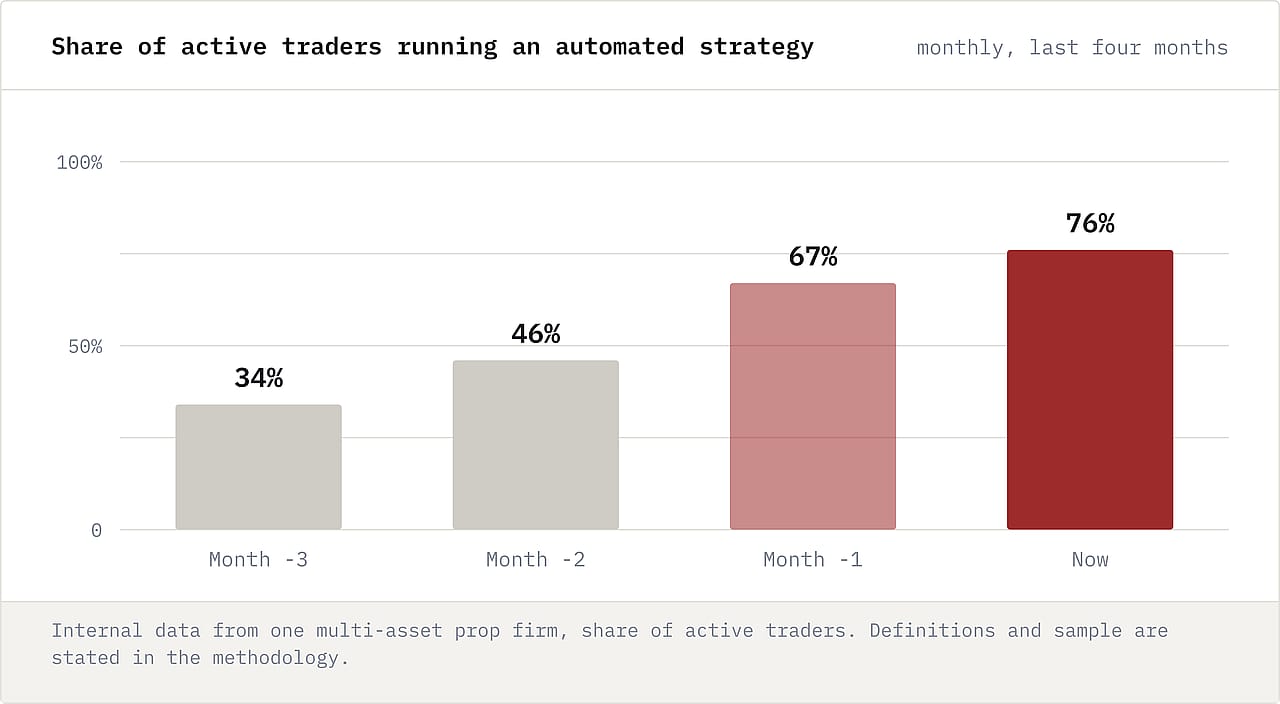
Platform-level data points the same way. According to internal data from one multi-asset prop firm, the share of active traders running at least part of their strategy through an API or an automated system rose from 34% to 76% over four months. Sample size, data period, account population, the definition of an automated account and the calculation basis are set out in the methodology below.
Velotrade
That is one firm’s book over one window rather than an industry measurement, but the direction of travel is not in dispute. Which makes the rules these traders operate under worth reading closely, because most were written for someone clicking a mouse.
Two kinds of restriction, filed under one heading
Start with the clauses that are hardest to argue with, because they are the majority and they obscure the picture if left in.
Most of the firms reviewed restrict high-frequency trading, latency exploitation or arbitrage. These are not anti-automation rules. Latency arbitrage and simulated-fill exploitation extract money from a pricing model rather than from the market, and a firm underwriting that risk is not being restrictive by prohibiting it, it is protecting its own solvency. The same applies to running one strategy across many accounts, which turns an apparently diversified book into a single correlated position.
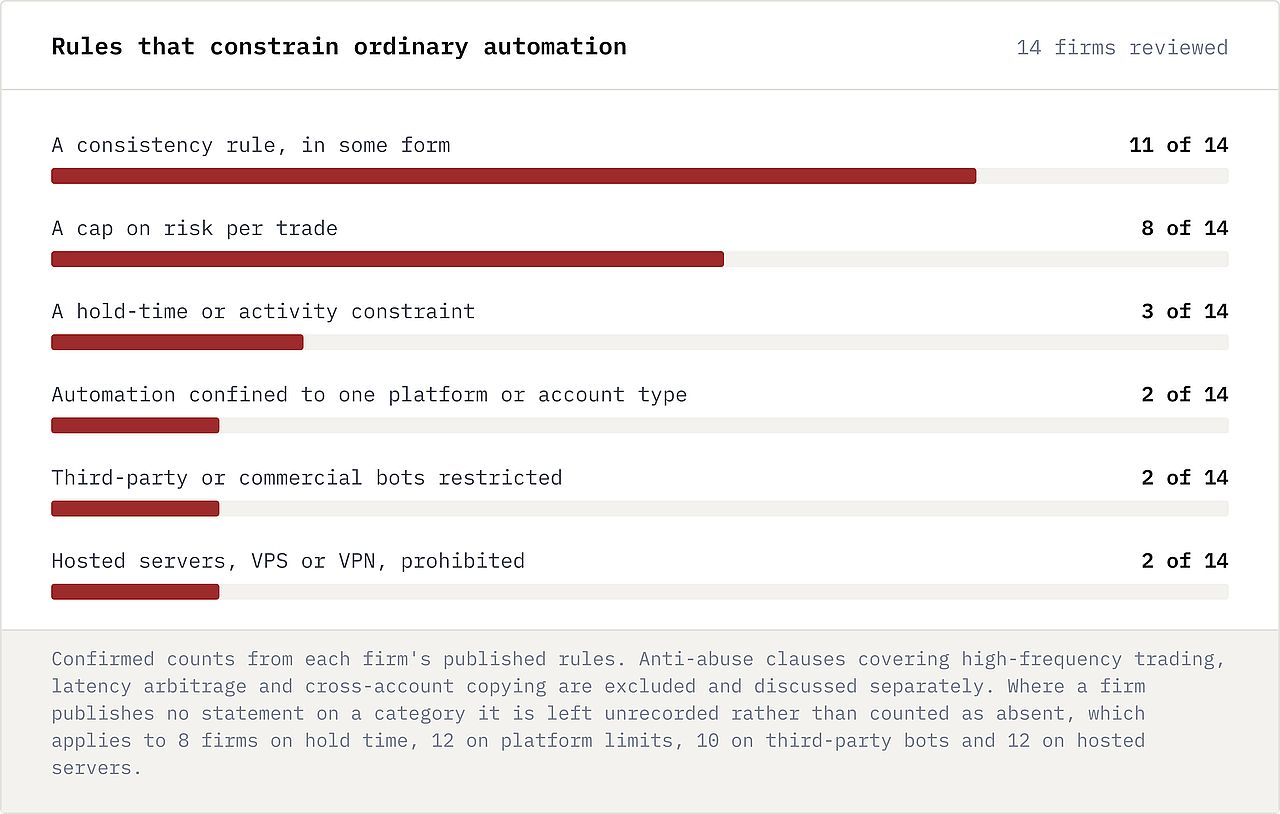
A second category sits in the same documents, under the same headings, and does something different. These clauses do not target abuse. They shape how an ordinary automated strategy is allowed to behave, and a trader who reads only the summary statement that expert advisors are permitted is unlikely to find them before funding.
Velotrade
The consistency rule, and what it is measured against
A consistency rule caps how much of a trader’s profit may come from a single day. It is the most common constraint in the set, applying in some form at 11 of the 14 firms reviewed.
Its stated purpose is to filter out traders who pass on one fortunate trade. Applied to a system, it interacts differently. Trend-following and breakout strategies earn most of their return in a small number of large moves, so a flat curve punctuated by three strong days is the expected signature of those categories rather than evidence of luck.
Velotrade
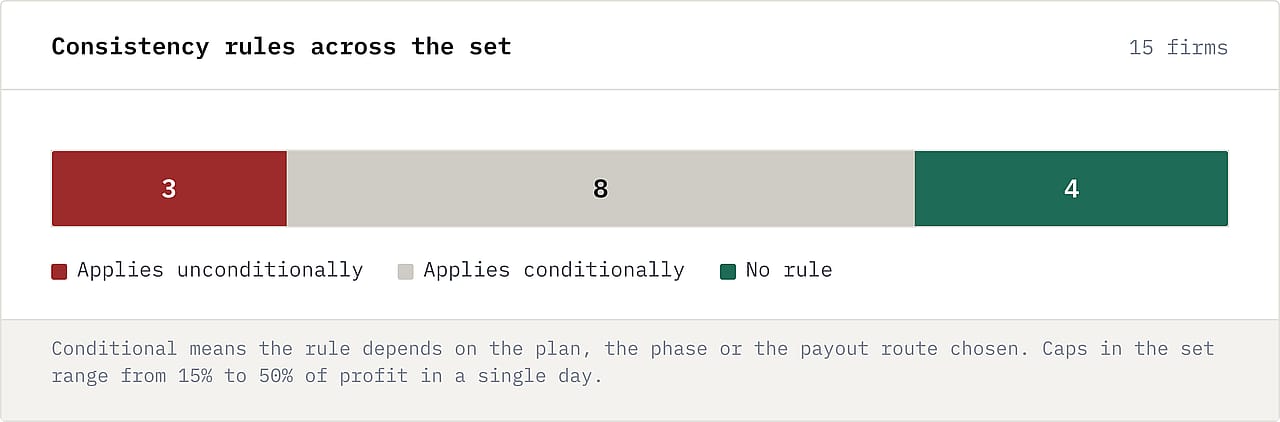
The headline percentage turns out to be the least useful part of the rule, because the quantity it is measured against changes from firm to firm. Among the three strictest, one requires that the best day not exceed 50% of profit earned on winning days only; a second caps a single day at 40% of the net result including losing days, and applies it during evaluation but not once funded; a third limits any one day to 30% of the amount requested in a payout, and applies it only on funded accounts. Eight more apply a version that depends on the plan, phase or payout route chosen, which is where it is easiest to miss: caps that bind on funded accounts but not during the challenge, checks that happen at payout rather than in evaluation, and rules waived on one payout cycle but enforced on another.
One finding holds across every firm reviewed: exceeding a consistency rule does not fail an account. The profit target is raised, the payout is blocked, or the excess is deducted. The trader stays in the evaluation, and the cost is time and continued market exposure rather than the account itself.
The clock, the server, and who wrote the code
Three further constraints matter more than their word count suggests.
The first is time. One firm prohibits holding more than half of trades for under a minute. Another forbids automated activity above 2,000 server requests a day. Individually, these read as reasonable anti-abuse measures. Collectively, they set a floor on how often a strategy may act, and a systematic approach that trades frequently but holds for minutes, neither high-frequency nor abusive, can run into them.
The second is infrastructure. A trader barred from a hosted server is left running a trading bot on a laptop that has to stay awake. Two firms in the set prohibit hosted servers, one requiring that all trading activity originate from the trader’s own device, the other restricting it on four account types for accounts purchased after a given date and not applying the change retroactively. Elsewhere, expert advisors are permitted on two named platforms only and only on accounts below $50,000. Most firms in the set run on the same pair of third-party retail platforms, which constrains what a strategy can be written in before any rule applies.
The third is authorship. Two firms restrict expert advisors that the trader did not write: one prohibits third-party and off-the-shelf software outright and reserves the right to request the source code as proof, the other permits it only where the trader owns the code. A purchased strategy arguably carries no more market risk than one written at home, so the clause functions less as a risk control than as a filter on how a trader arrived at an edge. Whether that distinction is worth drawing is a judgment each firm is entitled to make. The point for a trader is that it is rarely visible before purchase.
What to check before paying an evaluation fee
None of these clauses is hidden, and the firms applying them are not acting in bad faith. But filing anti-abuse rules and constraints on ordinary automation under one heading means a trader cannot easily tell them apart without reading the whole document.
The distinction is worth drawing because the two categories point in different directions. Prohibiting latency arbitrage defends a firm against a strategy designed to exploit it. Prohibiting a purchased expert advisor, a hosted server, or a profit curve with three strong days in it addresses no comparable exposure, and narrows the population of traders who can realistically pass.
For a trader deciding where to put an evaluation fee, the statement that trading bots are permitted carries almost no information, since it is true nearly everywhere. Four narrower questions carry considerably more, and the answers are worth confirming in writing before purchase:
- When does the consistency rule bind? During the challenge, on the funded account, or only at payout. The same headline cap costs a very different amount depending on the answer, and eight of the 14 firms make it conditional on the plan or payout route chosen.
- Is there a floor on hold time, or a cap on activity? This is the clause that decides whether a high-turnover strategy is viable at all, and it usually sits several pages into the terms.
- May the code run on a server? A prohibition on VPS or remote servers rules out most hosted deployments and forces a strategy onto a machine that the trader keeps running.
- Must the strategy be the trader’s own? Two firms in the set restrict purchased expert advisors, one of them reserving the right to request source code.
Each of those four is coded for all 15 firms in the full rules review behind this article, which names every firm and links to the page each rule was read on, and in the underlying rules data set. None of them appear on the page that says bots are welcome.
Methodology
- Sample: 15 proprietary trading firms, selected for market visibility in the crypto and multi-asset segment. Velotrade is included and identified in the disclosure.
- Source: each firm’s own published rules, terms of service and FAQ pages. No third-party aggregator data was used.
- Collection window: April to August 2026, with all 14 other records re-verified against each firm’s own rules page, FAQ and terms on Sept. 9, 2026.
- Coding: a firm is counted in a restriction category when its published rules state that restriction explicitly. Rules that vary by plan, phase or payout option are coded as conditional rather than as present or absent.
- Where a firm’s own pages disagree with each other, both readings are recorded rather than resolved in the firm’s favour or against it.
- Limits: published rules are not the same as enforcement practice, and this review measures only what firms state. Two firms in the set publish sparse terms, and absence of a stated rule was not treated as evidence that no rule is applied.
- Platform data: adoption figures are internal records from Velotrade, covering [n] accounts over [data period]. The account population is active trading accounts, meaning accounts that placed at least one trade in the month, across evaluation and funded accounts. An account is counted as automated when its orders arrive through the API or an attached automated system rather than the platform interface. Each month is a share of that month’s active accounts, not a cumulative figure. These figures describe one firm’s book over one window and are observational.
Sources
Rules were read on each firm’s own published pages between April and August 2026 and re-verified Sept. 9, 2026. Market-size and growth figures: Mordor Intelligence, Algorithmic Trading Market, retrieved Sept. 8, 2026.
The platform figure is internal data from Velotrade, a multi-asset prop firm. It covers active trading accounts, meaning accounts that placed at least one trade in the month, across evaluation and funded accounts. An account is counted as automated when its orders arrive through the API or an attached automated system rather than the platform interface. Each month is a share of that month’s active accounts, not a cumulative figure. Sample size and date range are stated in the methodology above.
This story was produced by Velotrade and reviewed and distributed by Stacker.


